Custom plush is having a moment as a business tool, and it is a different purchase from the one-off keepsake of a family pet. A company ordering stuffed animals is usually buying a mascot people will actually want, a trade-show giveaway that survives the flight home, a retail or licensed line, or a fundraising piece — often in the hundreds or thousands. The decisions that matter for that kind of order are size, quantity, lead time, and one compliance step that is easy to overlook and expensive to get wrong. Here is how to scope a custom plush program for a business so the result looks professional, arrives on time, and is legal to hand out.
Where custom plush earns its keep
Start by naming the job, because it sets every spec downstream. A brand mascot plush is merchandise and a brand ambassador, so it justifies a larger size and better fabric. Trade-show and event giveaways favor a small, light, inexpensive form — a pocket plush or a keychain mini that a visitor will clip to a bag and carry past thousands of other people. Employee and customer gifts sit in the middle, where perceived quality matters more than unit cost. A retail or licensed line has to hit a landed cost that leaves margin at the shelf price. And fundraising and cause plush trade on emotional pull, where a huggable standard size outperforms a token mini. One product rarely serves two of these jobs well, so decide the use case before you decide anything else.
Size and format drive the cost more than anything
Among all the variables, physical size moves the per-unit price the most, because it is mostly a story about how much fabric and fill go into each piece. A keychain mini at roughly 8–10 cm is the cheapest promotional format; a pocket plush at 15–20 cm reads as a real toy at a modest step up; a standard retail plush at 25–30 cm is the huggable size most people picture; and a jumbo display piece at 50 cm and up climbs steeply in cost. The chart below shows indicative per-unit prices by size at around a thousand pieces; treat the figures as directional, since fabric type (short-pile versus long-pile or minky), construction complexity, and added features all shift them.
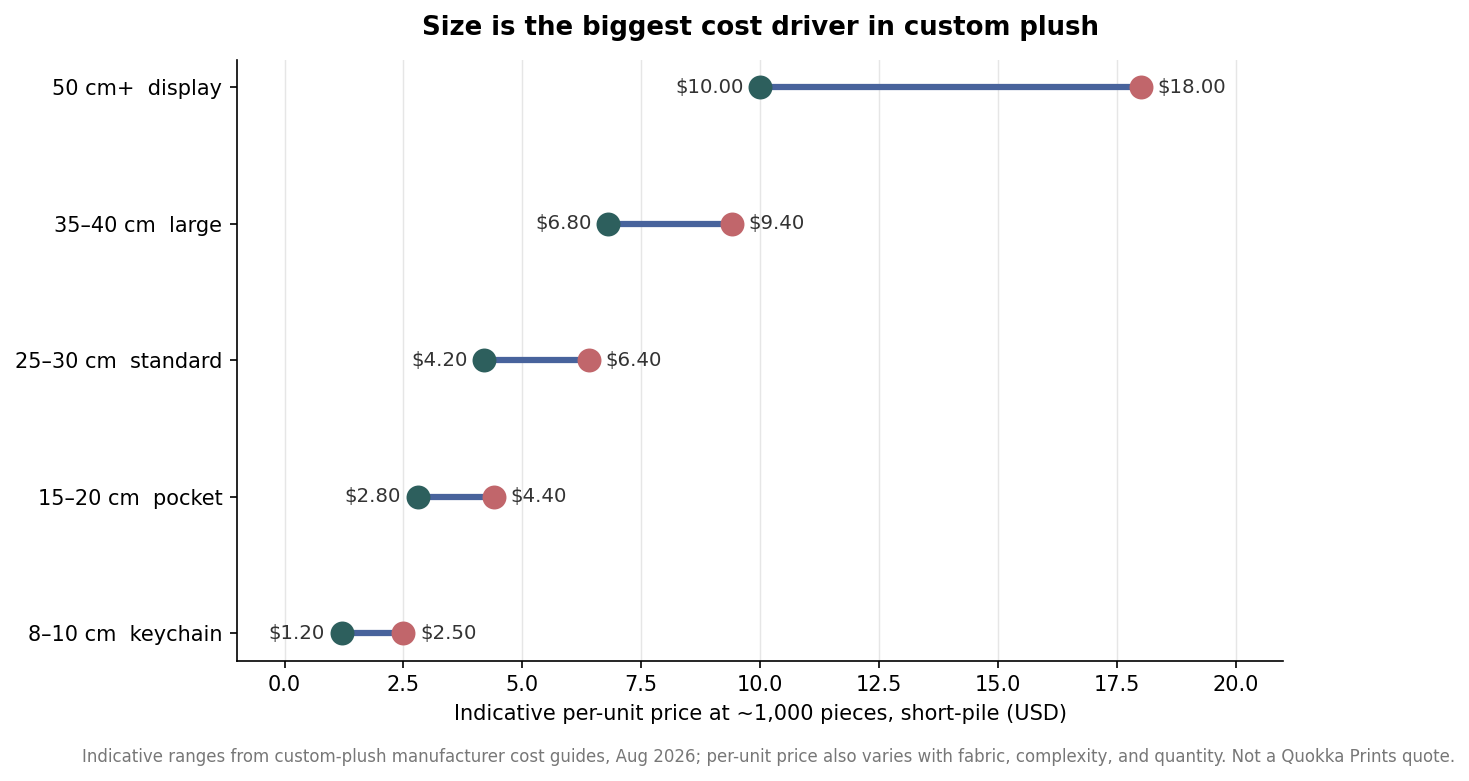
Complexity compounds size. Every extra seam, color, appliqué, embroidered detail, and accessory adds pattern work and handling. A clean, simplified silhouette not only costs less to make, it usually reproduces your character more faithfully at plush scale than a design crammed with fine detail — the same reason simple logos embroider better than busy ones.
Minimums, setup fees, and lead time
Custom plush is a tooling-and-sampling business, so two costs sit outside the per-unit price. The first is a one-time setup and sampling outlay — pattern making, embroidery digitizing, color-match testing, and one or more physical sample rounds — that commonly totals somewhere in the range of a few hundred to roughly nine hundred dollars for a first-time program before a single production unit is made. The second reality is the minimum order quantity: fully custom plush typically starts in the low hundreds of pieces, with per-unit price falling sharply as you move up the quantity tiers.
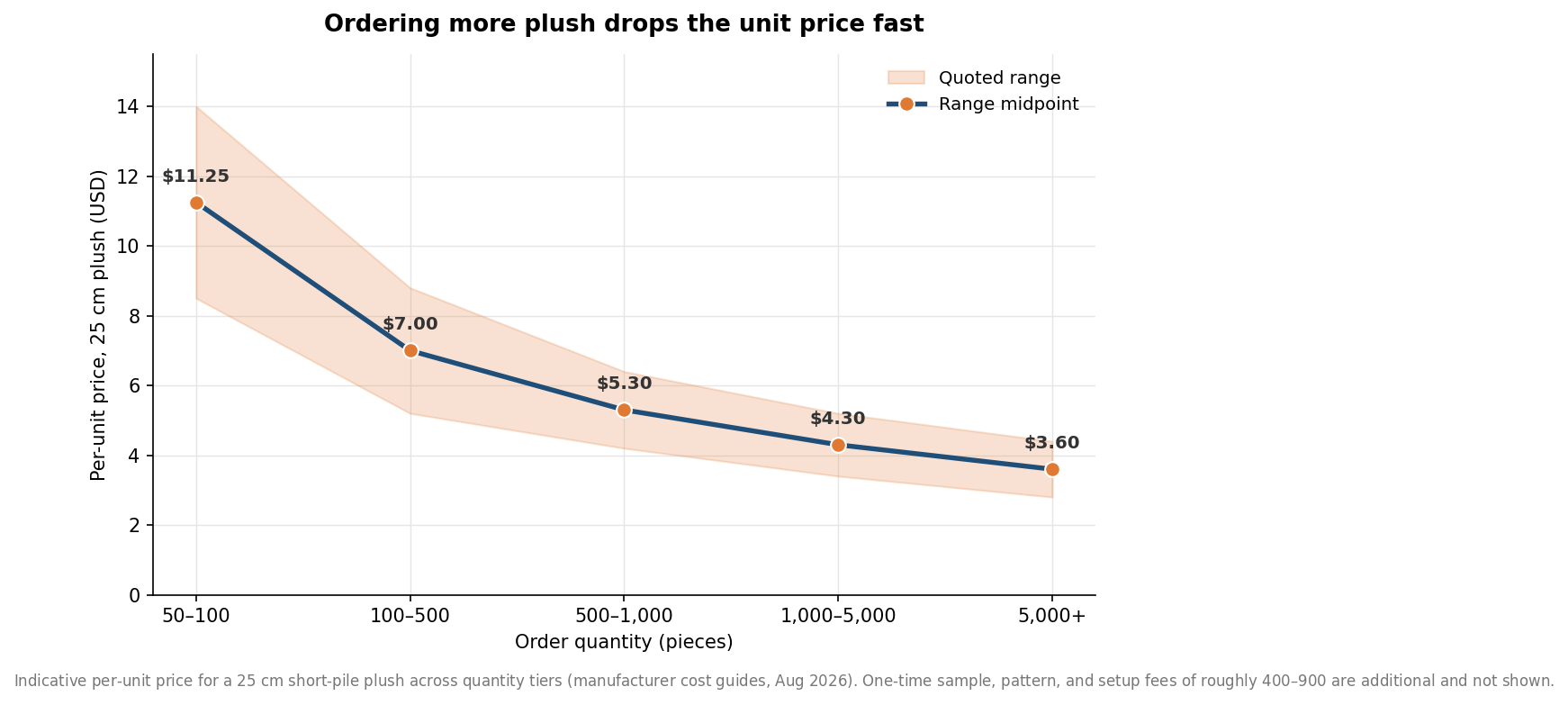
Lead time is the number that derails events. From approved concept art, expect sampling to take roughly two to three weeks, mass production another 30 to 45 days, and ocean freight a further four to six weeks port to port — a total that commonly lands around 75 to 110 days from concept to warehouse. Back-plan from your in-hand date, and if a launch or trade show is fixed, either start months ahead or budget for air freight to buy back weeks at a premium.
The safety step businesses skip at their peril
This is where a promotional order most often goes wrong. In the United States, any toy intended for children twelve and under is governed by the CPSIA and the mandatory ASTM F963 toy-safety standard, which requires third-party testing at a CPSC-accepted lab and a Children’s Product Certificate documenting compliance, plus a permanent tracking label identifying the maker and production run. Testing covers mechanical hazards such as seam strength and small parts, flammability, and chemical limits on heavy metals and phthalates. The trap for businesses is the concept of foreseeable use: a plush handed out at a trade show or in a workplace predictably ends up in a child’s hands, so regulators can treat it as a children’s product even if you never called it a toy. If children may realistically receive your plush, plan and budget for compliance from the start.
Design choices follow from that. For anything a young child might handle, favor embroidered eyes and features over glued-on plastic parts or buttons, and reinforced seams, to clear small-parts and pull-test requirements. If the item is genuinely a collector or adult product, it must be honestly age-graded and marketed that way — labeled for older ages and not styled or promoted to young children — rather than treated as a loophole. Because the specifics turn on your exact design and audience, confirm the testing scope with your manufacturer and a qualified toy-testing lab before production; the cost of testing is small next to a recall or a blocked shipment.
A quick ordering checklist
Put the program on one page before you request quotes. Name the use case and the size that fits it; set the quantity against your budget and the tier pricing; simplify the design to the fewest colors and parts that still read as your character; decide the audience and therefore the compliance path; and back-plan the timeline from a real in-hand date including sampling and freight. Ask each supplier for a physical pre-production sample, the total setup cost, the tiered per-unit pricing, and exactly what safety testing and documentation are included. Get those answers in writing and a custom plush program stops being a gamble and becomes a predictable, repeatable piece of your brand.