A custom stuffed animal is not just a marketing object. The moment a plush is designed for, marketed to, or reasonably expected to end up in the hands of children twelve and under, it becomes a regulated children’s product, and a stack of federal rules attaches to it. Business buyers who order plush as giveaways, retail merchandise, or fundraising items are the manufacturer or importer of record in the eyes of regulators, which means the compliance burden lands on you, not only on the factory. Getting this right before you place the order is far cheaper than a recall or a blocked shipment.
This guide walks through the U.S. framework that governs custom plush, the European rules if you ship abroad, and the practical steps that keep a promotional order on the right side of the line.
The U.S. framework: CPSIA and ASTM F963
The Consumer Product Safety Improvement Act is the backbone. It makes the toy safety standard, currently ASTM F963-23, a mandatory federal requirement rather than a voluntary guideline. ASTM F963 covers the physical and mechanical properties of a toy, flammability, and the migration of certain heavy metals from surface coatings. For plush specifically, it drives the tests that matter most: seam strength, attachment of eyes and noses, and the absence of hazardous sharp points or liberated small parts.
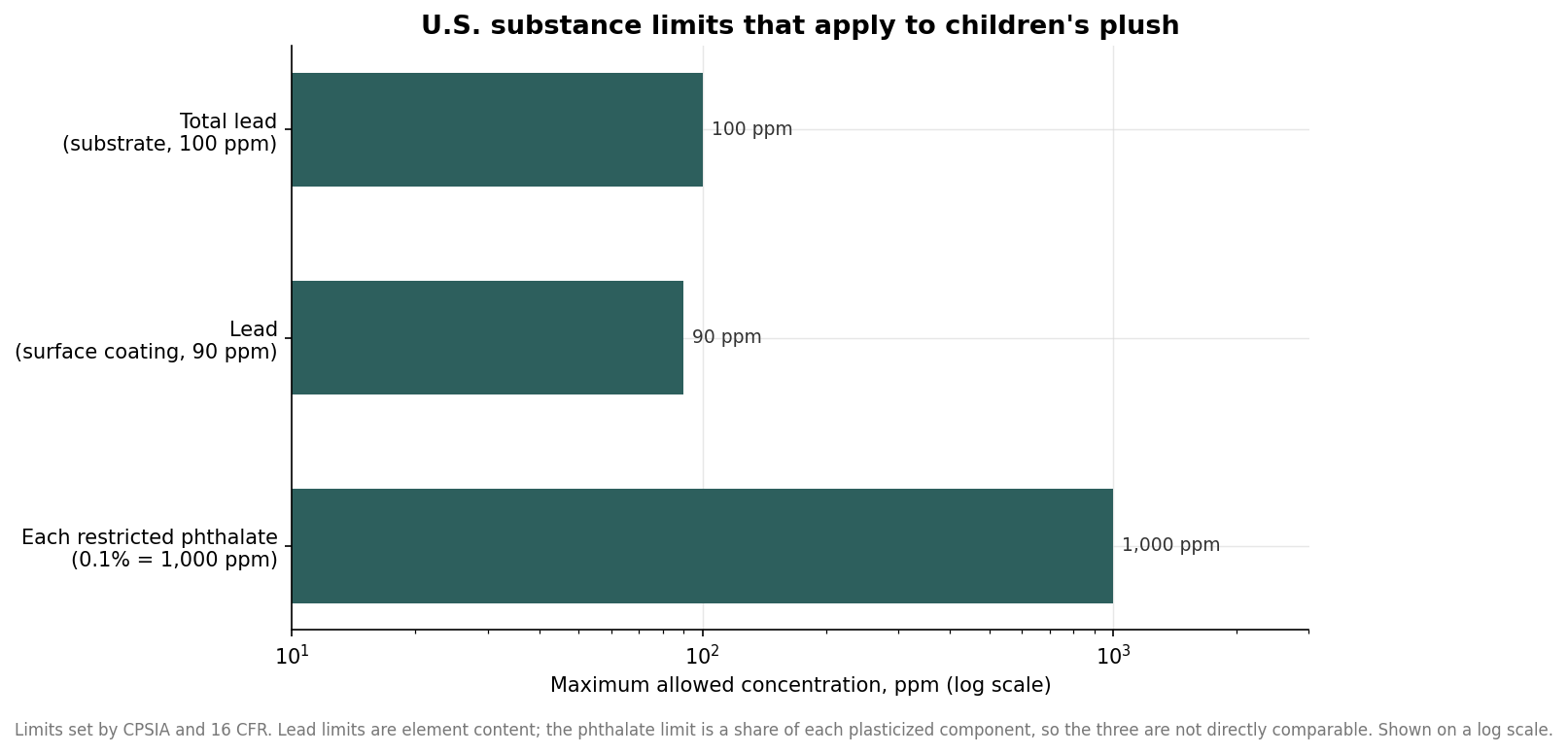
On top of the toy standard, CPSIA sets hard chemical limits. Total lead in an accessible substrate is capped at 100 parts per million, lead in surface coatings and paint at 90 parts per million, and each of the restricted phthalates at 0.1 percent, which is 1,000 parts per million, in plasticized components such as plastic eyes or appliqués. The chart below shows those thresholds together, though they are measured on different bases and should not be read as directly comparable.
Testing, certification, and tracking labels
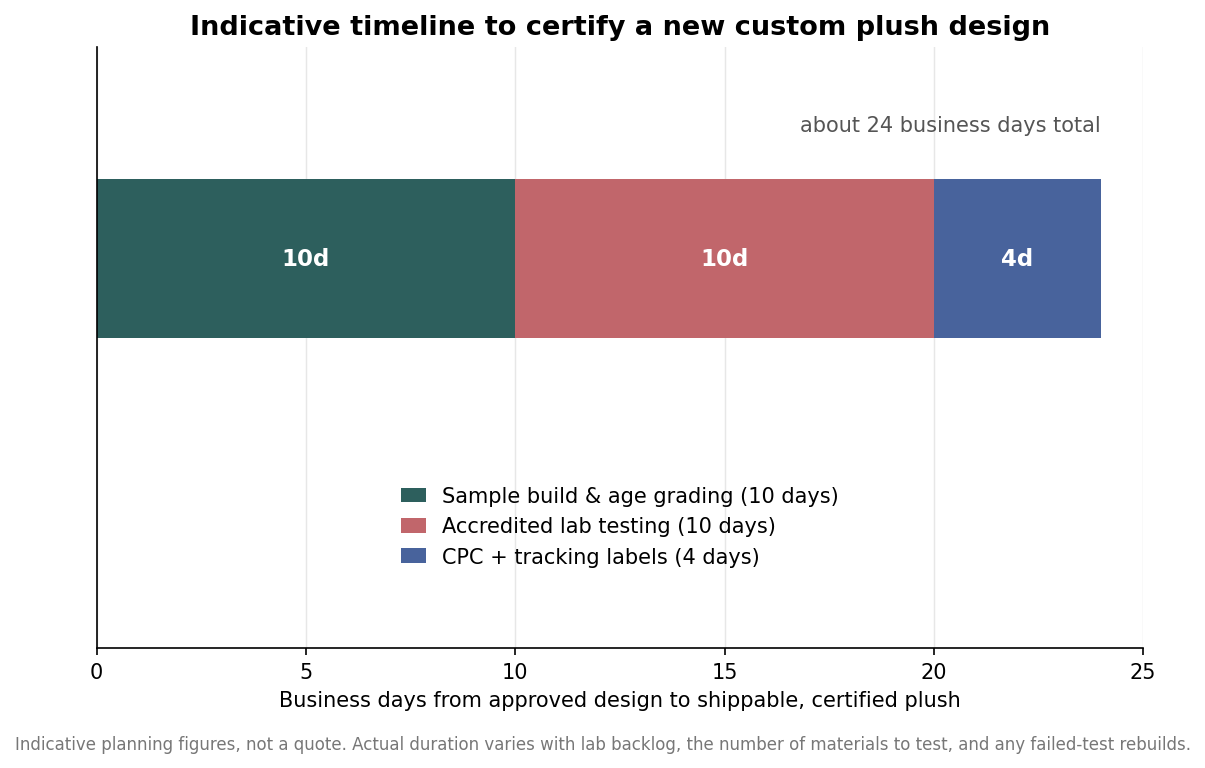
Children’s products require third-party testing at a CPSC-accepted laboratory. Once the plush passes, you issue a Children’s Product Certificate, the document that declares which rules the product was tested against, identifies the testing lab, and names the party taking responsibility. Retailers and customs officers can ask for it, and importing without one is a common way for a shipment to get held.
CPSIA also requires a permanent tracking label on the product and its packaging. The label carries enough information to trace a unit back to its production run: the manufacturer, the production location and date, and a batch or cohort identifier. On a plush toy this usually lives on a sewn-in tag. It is easy to overlook at the artwork stage and expensive to add after production, so specify it up front. The same tag is a natural place to carry your brand and any required care or content statements, so treat it as part of the design rather than an afterthought bolted on at the end.
Small parts and age grading
Age grading decides how strict the rules get. If a plush is intended for children under three, it must contain no small parts that fit entirely inside the small-parts cylinder defined in 16 CFR 1501, because anything that small is a choking hazard for that age group. In practice this is why infant and toddler plush uses embroidered eyes and noses rather than plastic safety eyes, and why every attached feature has to survive the use-and-abuse pull, torque, and tension tests without coming loose.
If the plush is graded for children three and over and does contain small parts, it must instead carry the choking-hazard warning required by 16 CFR 1500.19, the familiar statement that the item is not for children under three years. Choosing the age grade is therefore not a marketing decision you make at the end. It changes the construction, the components, and the labels, so make it at the start with your factory and your test lab aligned. Regrading a design after the samples are built almost always means rebuilding them, which is exactly the kind of avoidable delay that pushes a seasonal promotion past its window.
Shipping to Europe and beyond
The European rules run on a parallel track. Toys sold in the EU must meet the EN 71 series, which covers mechanical and physical properties in EN 71-1, flammability in EN 71-2, and the migration of certain elements in EN 71-3, and they must carry the CE mark backed by a technical file and an EU-based responsible person. Note that the EU is in the middle of moving from the long-standing Toy Safety Directive to a new Toy Safety Regulation, so confirm the current requirements and transition dates before you commit to a European shipment rather than relying on last year’s checklist.
When plush is genuinely not a toy
Not every promotional plush is a regulated toy. An item designed and marketed for adults, a desk mascot for a trade-show booth aimed at a professional audience, can fall outside the children’s-product rules. But the test is intent and reasonable expectation, not your stated hope. If the plush is cute, soft, and handed out where families gather, a regulator will treat it as a children’s product regardless of the disclaimer on your order form. When in doubt, the safe and honest move is to build and test it as a toy. It costs more, and it is the difference between a giveaway that builds your brand and one that becomes a liability. Lock the age grade, the materials, and the certification path in the same conversation where you approve the artwork, and the rest of the project runs smoothly.